
ISO 27001 vs SOC 2: Which One Does Your Startup Actually Need First?
Most startups don't need both ISO 27001 and SOC 2. Some don't need either — yet. But almost every founder ends up worrying about them too early, too late, or for the wrong reasons.
The problem? Advice around compliance is full of generic best practices and not enough context. So founders end up asking the wrong question: "Which certification is better?"
The real question is: which one helps me close deals right now?
This article will help you answer exactly that, without wasting months on the wrong path.
What Is ISO 27001?
ISO 27001 is an international standard for building and maintaining an Information Security Management System (ISMS). Think of it as a blueprint for how your company handles security — not just a checklist, but a living system.
It tells the world: we don't just have security tools — we have a structured program with documented policies, defined ownership, ongoing risk management, and continuous improvement baked in.
What getting ISO 27001 actually involves
The process typically takes 6–18 months depending on your current security maturity. You'll need to document your policies, conduct a formal risk assessment, define and implement controls from Annex A (93 controls across 4 themes), train your team, run an internal audit, and then go through an external certification audit in two stages.
The effort is real. But so is the signal it sends, especially to enterprise buyers and procurement teams who need documented evidence of security governance before signing large contracts.
What Is SOC 2?
SOC 2 is an audit report, not a standard or certification. It was created by the American Institute of CPAs (AICPA) specifically for technology companies that handle customer data.
Rather than certifying that you have a system in place, SOC 2 verifies that your controls meet specific Trust Service Criteria — and that you've been consistently following them.
Type I vs Type II — what's the difference?
The Snapshot
Confirms that your controls are designed correctly at a specific point in time. It can be obtained quickly and is often a useful first step for early-stage startups that need something to unblock a deal.
2–3 monthsThe Real Prize
Covers a review period (typically 6–12 months) and proves your controls actually operated effectively over time. This is what mature enterprise buyers expect and what carries the most weight in competitive sales processes.
6–12 monthsThe five Trust Service Criteria
SOC 2 can cover up to five criteria — most startups start with just Security (required), and optionally add Availability, Confidentiality, Processing Integrity, or Privacy depending on their product.
Key Differences That Actually Matter
Here's what matters for your decision as a founder:
| Factor | SOC 2 | ISO 27001 |
|---|---|---|
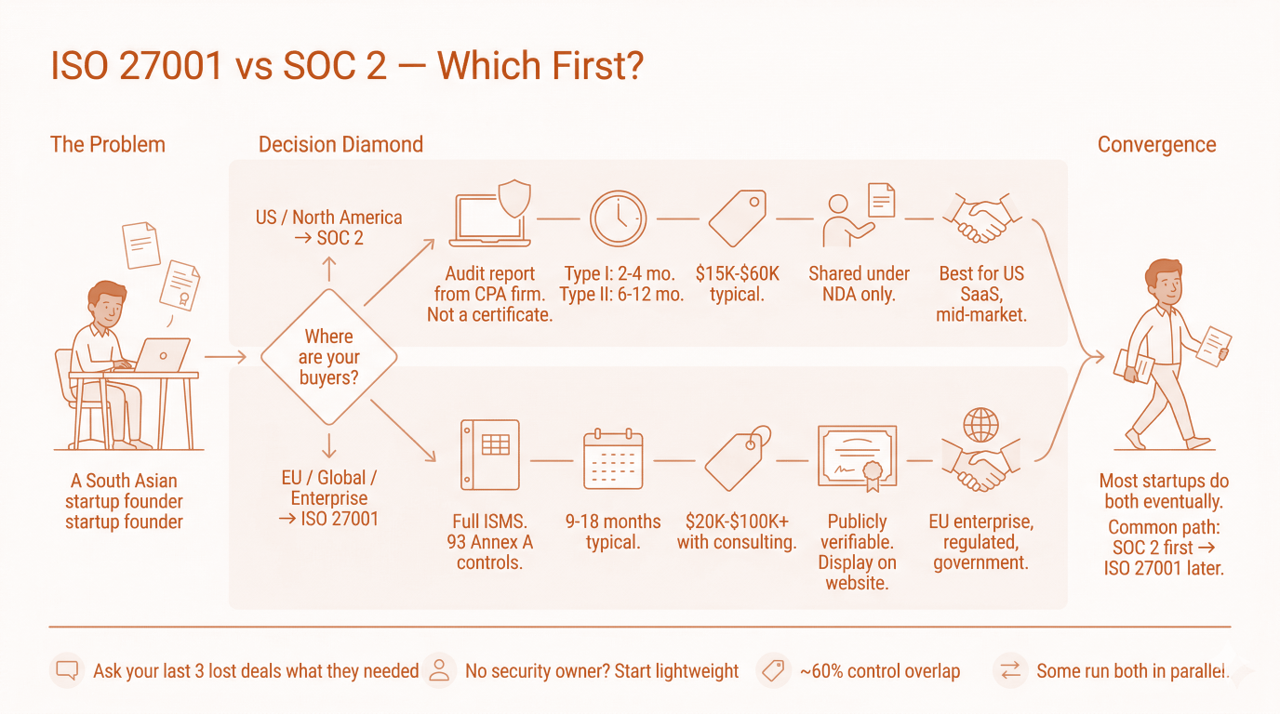
| Geography | US / North America dominant | Europe / Global preferred |
| Output | Audit report (shared under NDA) | Certificate (publicly verifiable) |
| Time to achieve | Type I: 2–4 months / Type II: 6–12 months | Typically 9–18 months |
| Typical cost | $15k–$60k (audit fees + tools) | $20k–$100k+ (consulting + audit) |
| Internal effort | Moderate — control implementation | Heavy — full ISMS build-out |
| Best for closing | US SaaS, mid-market, tech buyers | Enterprise, government, EU clients |
| Recurring | Annual audit to stay current | 3-year cert + annual surveillance |
| Perceived weight | High in US, low outside it | High globally, especially enterprise |
When Your Startup Should Choose SOC 2 First
SOC 2 is often the right first choice if you're in a US-centric market, moving fast, and need to unblock deals without a 12-month security overhaul.
- US-based SaaS companies
- Tech startups and scale-ups
- Mid-market companies with security reviews
- US investors conducting vendor audits
- Deals stalling at the security review stage
- Prospects asking "do you have SOC 2?"
- Seed to Series B stage
- Need a trust signal within 6 months
The smart path for early-stage startups
If you're pre-SOC 2 and need something now, consider using a security questionnaire response plus a pentest report to unblock early enterprise deals while you work toward Type I. Many US buyers will accept this at under $50k ACV.
When Your Startup Should Choose ISO 27001 First
ISO 27001 makes sense as your first certification when you're playing in global markets, regulated industries, or enterprise sales where procurement checklists come from legal teams in Frankfurt or Singapore — not San Francisco.
- EU or UK enterprises
- Government or public sector clients
- Regulated industries (finance, health, legal)
- Large multinationals with global procurement
- Expanding internationally from day one
- Prospects mention GDPR, DORA, or NIS2 compliance
- Building a structured security program anyway
- Targeting $100k+ contracts requiring formal ISMS
Can, And Should, You Do Both?
Yes. And eventually, most scaling B2B startups do. But timing is everything.
The most common path
Type I
Type II
27001
Maintained
The most common path for US-founded startups expanding internationally is SOC 2 first, ISO 27001 later. SOC 2 gets you moving in your home market. ISO 27001 opens the global enterprise door when you're ready.
When it makes sense to pursue both early
There are cases where doing both in parallel (or close together) is justified — if your sales pipeline includes significant enterprise deals in both US and EU markets simultaneously, or if you're in a regulated industry where multiple frameworks are expected from day one (healthcare, financial services, critical infrastructure).
A Simple Decision Framework
Use this checklist before committing to any compliance path. The answers will point you in the right direction far more reliably than any generic recommendation.
Where are your customers located?
US-only → lean SOC 2. EU/global/enterprise → lean ISO 27001. Mixed → assess your pipeline split.
What do your prospects actually ask for?
Pull the last 10 security questionnaires you received. Which frameworks did they reference? That's your market's signal.
How fast do you need deals to close?
If compliance is blocking specific deals right now, SOC 2 Type I (2–3 months) might be your fastest unblock. ISO 27001 is a longer commitment.
Do you have a security owner?
No dedicated security person → start with lighter controls before either framework. Yes → assess readiness and start planning.
